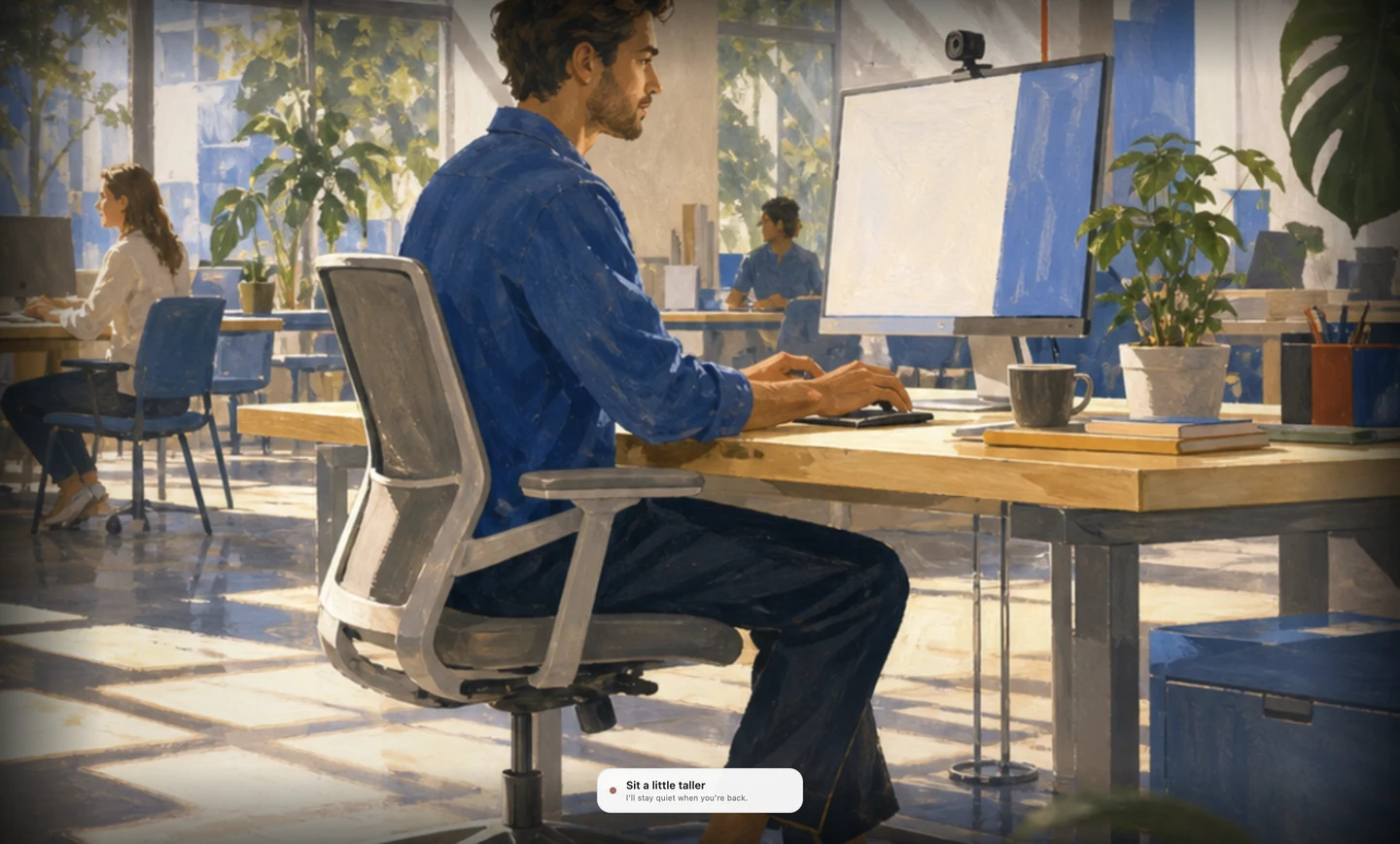
The short answer
Choose quiet reminders or points, levels, and scores.
SuperShrimp turns good posture into scores, XP, levels, and a leaderboard. Plumb shows one quiet reminder after you remain slouched and clears it when you sit back up.
Show Plumb how you sit, receive a quiet alert after you remain slouched, and keep your posture history on your Mac.
More visual feedback, competitive mechanics, and account-like concepts around a posture habit.
Your free trial starts with the first monitoring session, not the download.
At a glance
Plumb vs SuperShrimp at a glance
Compare what each product asks you to install, wear, permit, notice, and pay for.
| What changes for you | Plumb | SuperShrimp |
|---|---|---|
| How it notices posture | On-device Mac camera model, calibrated to three personal positions | Webcam analysis using on-device AI |
| How it responds | A quiet reminder after posture drift persists | A notification with posture preview when the score drops |
| Personal setup | Learns upright, natural slump, and looking-down positions | Camera-based scoring; the public page does not describe a comparable three-pose calibration |
| What progress looks like | Local posture time, recoveries, and longer-term trends | Good versus bad posture time, daily and weekly scores, XP, ten levels, and a leaderboard |
| Where it works | macOS | macOS, Windows, and Linux |
| What you need | A Mac and a useful camera angle | No wearable; built-in, USB, or Continuity Camera support |
| Before you pay | Complete 3-day trial with no card or account | No free tier; 30-day money-back guarantee |
| Price checked 23 July 2026 | $3.99 monthly, $34.99 annually, or $45 founding lifetime | $17 launch lifetime price, planned to rise to $29 |
The daily routine
Compare quiet reminders with points, levels, and scores.
Plumb clears its reminder when you sit back up. SuperShrimp turns posture into a game with scores, XP, levels, and a leaderboard.
SuperShrimp requires no wearable; built-in, USB, or Continuity Camera support. It supports macOS, Windows, and Linux. Check whether that hardware and platform setup works at the desk where you need reminders.
Show it upright, your natural slump, and the position you use when looking down.
Plumb processes the camera view on your Mac and ignores brief reaches and shifts.
A quiet cue appears after you remain slouched and clears when you return to the upright position you recorded.
The first week
How each product sends posture feedback
Plumb begins by asking for three examples from your real desk setup: upright, your natural slump, and the position you use when looking down. That gives the app a personal reference before it starts coaching. You then begin a monitoring session and continue working while classification stays on the Mac.
Plumb ignores brief movements. A quiet reminder appears after your posture stays outside the calibrated range. The reminder clears after you return, and Plumb records the recovery.
SuperShrimp uses camera-based scoring; the public page does not describe a comparable three-pose calibration. During use, it relies on webcam analysis using on-device AI and responds with a notification with posture preview when the score drops.
Plumb records posture time, recoveries, and longer-term patterns on your Mac. SuperShrimp offers good versus bad posture time, daily and weekly scores, XP, ten levels, and a leaderboard. Compare the reports and decide which measurements you would use.
Plumb waits, reminds you, and records recovery
A quiet cue appears after sustained slouching and clears after you return to your calibrated range.
Visible scores and game mechanics that reward consistency
Main drawback: More visual feedback, competitive mechanics, and account-like concepts around a posture habit.
The coaching experience
Choose private recovery tracking or visible game rewards.
Plumb waits to see whether a posture change lasts, then shows one quiet cue. The delay prevents brief reaches, reading positions, and normal movement from triggering alerts.
SuperShrimp responds with a notification with posture preview when the score drops. Its main advantage is visible scores and game mechanics that reward consistency. Its main drawback is more visual feedback, competitive mechanics, and account-like concepts around a posture habit.
After a Plumb reminder, returning to your calibrated range clears the cue. Plumb stores posture time, recoveries, and longer-term patterns on the Mac.
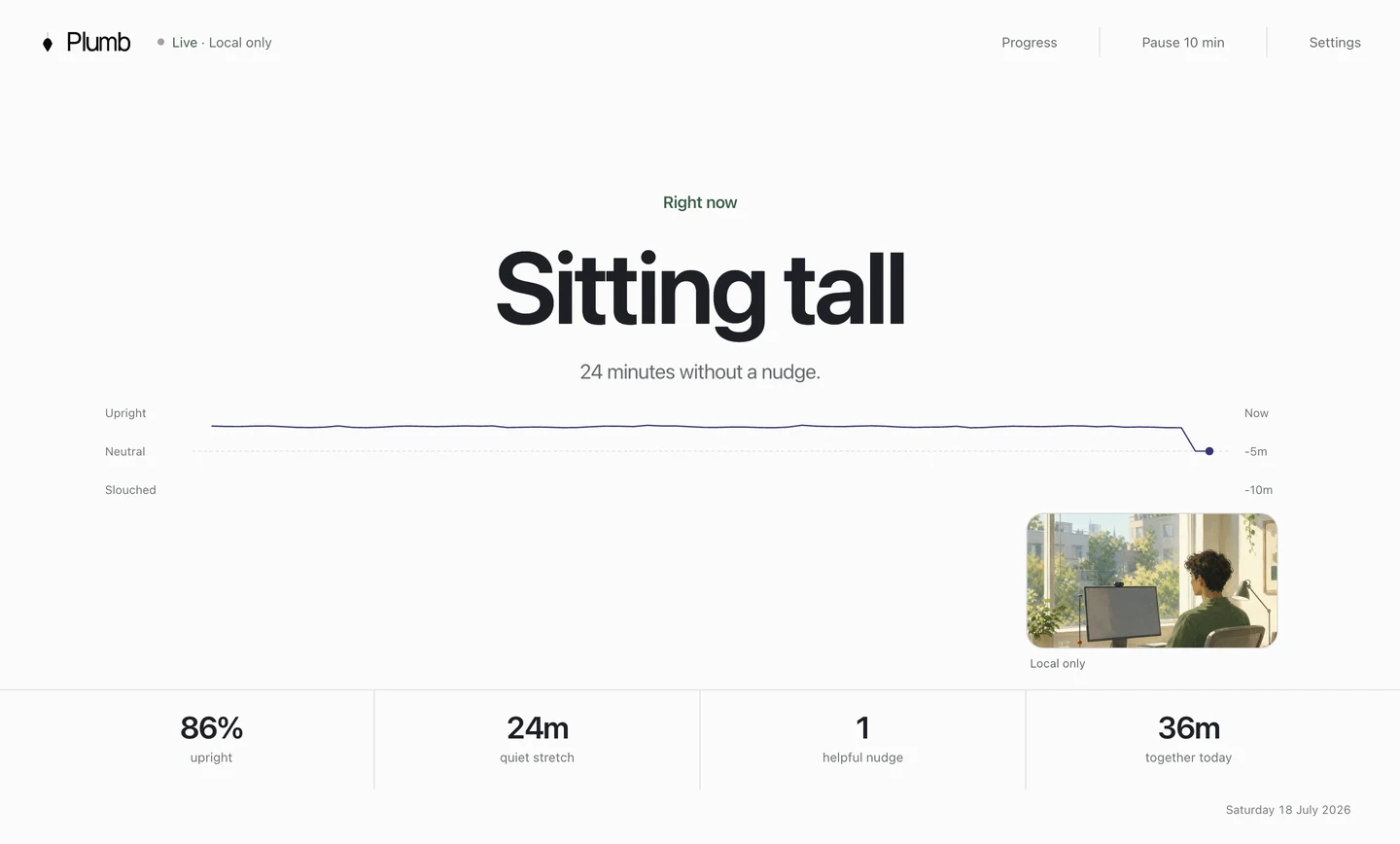
Record three positions, start monitoring, and receive a cue after you remain slouched for the delay you selected.
Pick your trade-off
Compare the daily setup and maintenance
- Want quiet reminders without scores or a game.
- Prefer private local progress without a leaderboard.
- Want three-pose personal calibration.
- Want a no-card trial before purchase.
- Respond to XP, levels, and visible scores.
- Need Windows or Linux support.
- Want a one-time lower launch price.
- Prefer detailed daily and weekly scoring.
Plumb only works on Mac and needs a clear camera angle. SuperShrimp has this drawback: more visual feedback, competitive mechanics, and account-like concepts around a posture habit.
Privacy and setup
Compare camera, device, and account privacy
Plumb uses the Mac camera to compare your current head and shoulder position with the three positions you recorded. It processes frames on the device, discards them during use, and keeps posture history on the Mac. Camera images and posture history are excluded from diagnostics. No account is required for the three-day trial.
That model still has a clear requirement: you must be comfortable granting camera access and have an angle that can see your working position. If your camera is closed, obstructed, or pointed away while using an external display, Plumb cannot coach the session properly.
SuperShrimp has this setup requirement: No wearable; built-in, USB, or Continuity Camera support. Its documented privacy position is on-device, offline detection; no webcam images are captured or stored. For some buyers, that removes the permission they care about most. For others, it adds hardware, account, sync, or platform requirements that make everyday use less convenient.
Read the privacy policy, check the required hardware or account, and test whether you can pause the product during calls and other unsuitable tasks.
Try before you commit
Compare trial terms and prices before paying
You can use Plumb’s complete coaching loop for three days without a card or account. The trial begins when monitoring starts, so downloading it early does not waste any of the trial.
For SuperShrimp, the documented trial is: No free tier; 30-day money-back guarantee. The price when checked was: $17 launch lifetime price, planned to rise to $29. Pricing can move, so confirm the current offer before buying.
No card. No account. No cloud posture history.
Common questions
Plumb vs SuperShrimp FAQ
Is Plumb better than SuperShrimp?
Plumb is the stronger fit for Mac users who want three-pose personal calibration, reminders after sustained drift, and local recovery trends. SuperShrimp is the stronger fit for people who prioritise visible scores and game mechanics that reward consistency.
What is the biggest difference between Plumb and SuperShrimp?
Plumb uses a quiet reminder after sustained posture drift. SuperShrimp provides a notification with posture preview when the score drops.
What equipment does SuperShrimp require?
No wearable; built-in, USB, or Continuity Camera support
How does SuperShrimp handle privacy?
On-device, offline detection; no webcam images are captured or stored
How much does SuperShrimp cost?
$17 launch lifetime price, planned to rise to $29. Pricing was checked on 23 July 2026; verify the current official offer before purchasing.